Chemistry AI

for Chemical R&D Teams

Turn Your Historical Experiment Data Into Predictive AI Models.
Why ChemCopilot

Operational in 3 steps.

No disruption to your existing process.

Leverage your data to get AI-driven insights in a matter of minutes.

1
Ingest your data
2
Visualize & model
3
Run AI simulations
Solutions

Built around how your team works

Insights in seconds, not weeks

Upload your data, papers, or patents — Chem Copilot builds an AI advisor tailored to your exact context.

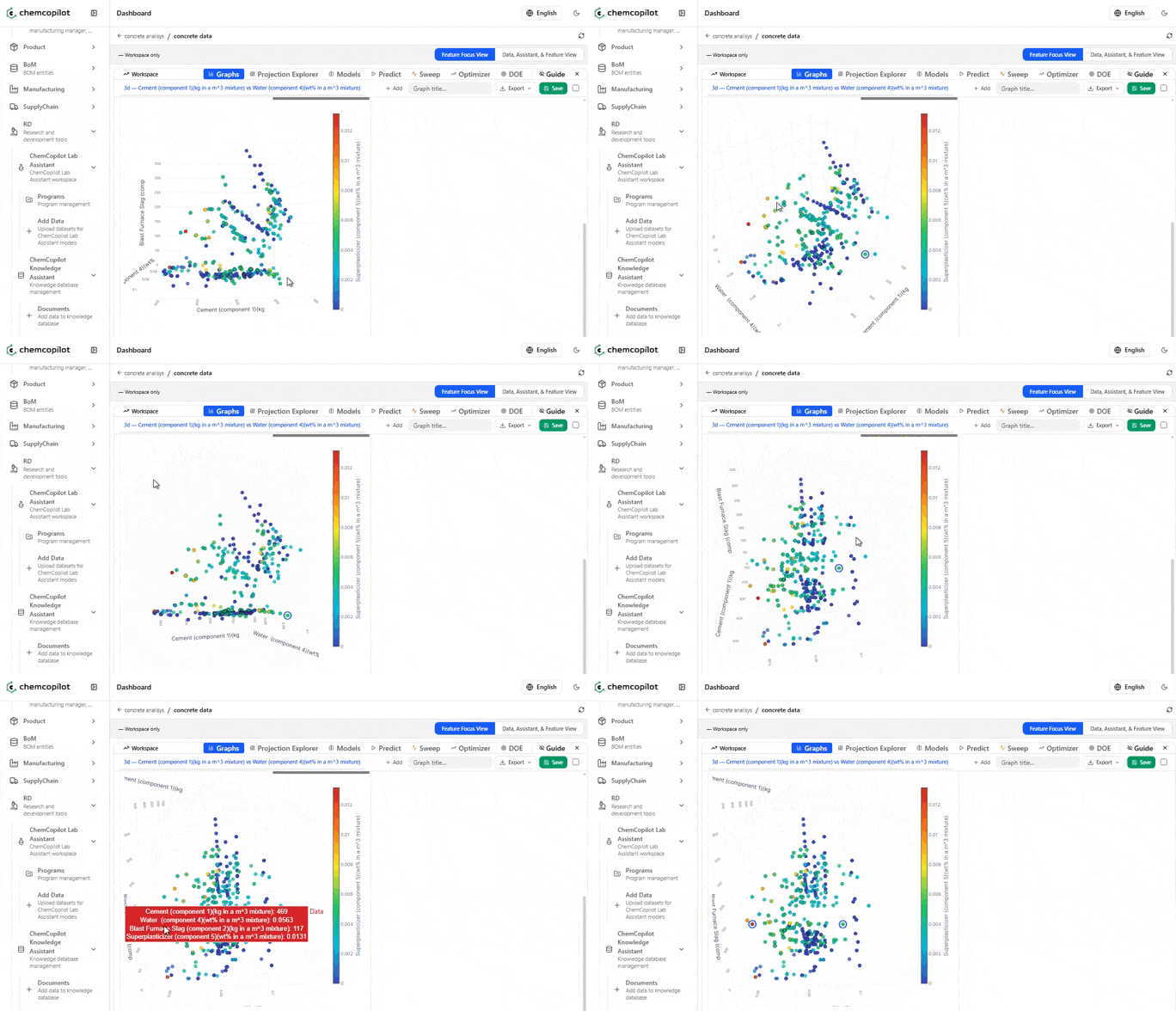
  • Visualize data in 2D, 3D and interactive graphs
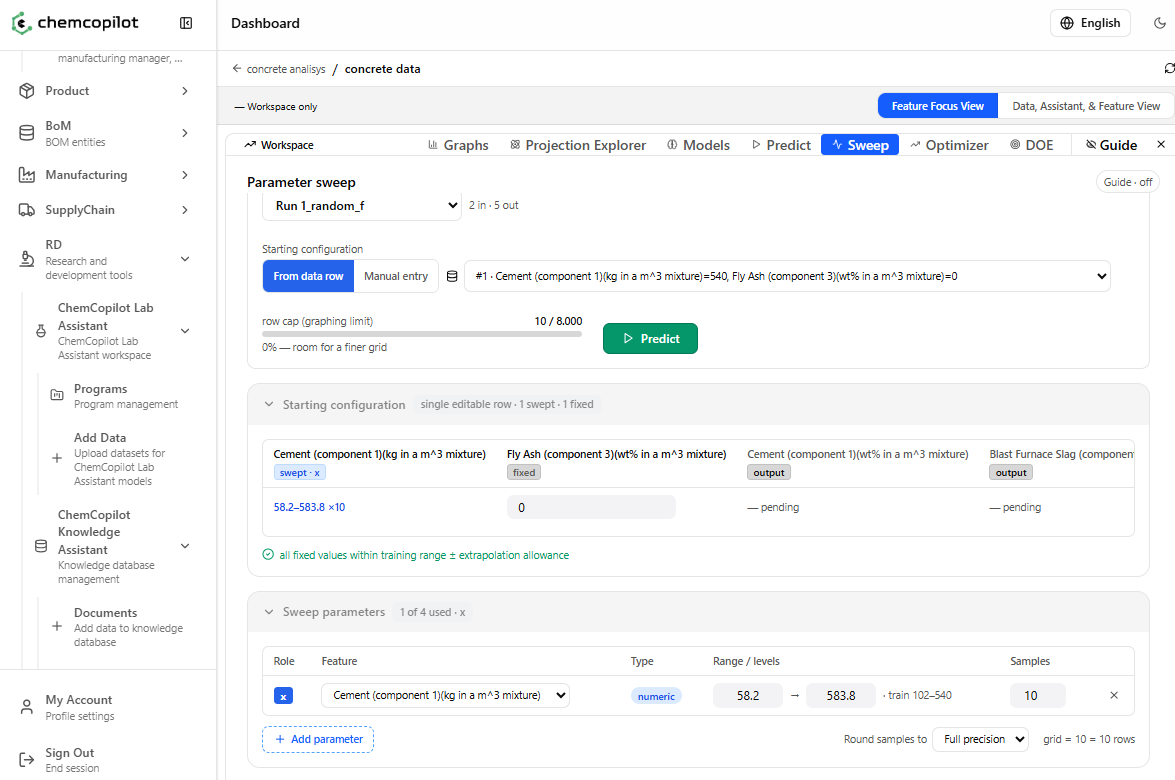
  • Predict outcomes and optimize your next experiment
  • No coding required
Talk to us about R&D
1
Upload your data — Excel, PDFs, lab notes
Done
2
AI builds a model from your data
Ready
3
Chat with your results, predict new scenarios
2.3s
4
Run targeted experiments instead of blind trials
Shipped

Centralize compliance. Stay ahead of change.

One knowledge base for your SDS, PDS, and formulation data — always current, always connected.

  • Centralize SDS and product datasheets
  • Link formulation data to compliance records
  • Monitor regulatory updates automatically
Talk to us about Compliance
1
Centralize SDS and product datasheets
Active
2
Link formulation data to compliance records
Live
3
Monitor regulatory updates automatically
Monitoring

Turn production data into a planning advantage

Use existing batch records and process history to model uncertainty and make confident scale-up decisions.

  • Run what-if simulations before touching the production line
  • Model feedstock variability against your yield targets
  • One data layer from R&D spec to production planning
Talk to us about Scale-up
Lab
Formulation locked from R&D
Done
Sim
What-if simulations across scale scenarios
2.1s
Plan
Optimal parameters transferred to production
Live

Accelerate your R&D

100X
faster DOE planning vs. manual methodology
2.3s
avg. query response across full dataset
99.8%
formulation validation accuracy
0
compliance violations in automated validation
chemcopilot.com/workspace
DOE Planner — Polymerization of Styrene
AI-optimized matrix — 48 runs → 6 runs
Experimental space reduced · Cost −87%
Temperature60–80°C optimal
Initiator conc.0.1–0.5 mol%
Reaction time4–8 h
Predicted yield88–94%
Matrix reduced from 48 → 6 runs. Time saved: 3 weeks → 4 hours.
Confidence
Yield prediction94%
Condition accuracy91%
Cost reduction87%
Runs needed6
Time to results4 h
Formulation AI — Coating v3.2
BOM optimized — all performance targets met
Cost reduced −14% vs previous version
Base polymer (Acrylic)42%
Crosslinker (Melamine)8%
Pigment TiO₂22%
Solvent blend28%
Viscosity 85 KU achieved. Gloss 92° achieved. Version locked.
Performance
Adhesion97%
Weather resistance89%
Sustainability score78%
Versionv3.2 — Locked
Records created+247 auto-structured
Digital Twin — Reactor Simulation
1
Historical data ingested — BOM + 3,200 batch records
Done
2
Reactor model calibrated from production data
Done
3
What-if: T +5°C → predicted yield +3.2%
Live — 2.1s
4
Optimal campaign parameters exported to production
Pending approval
Compliance — Product PD-0042
Validated against 12 regulatory frameworks
Automatically triggered on formulation save
REACH (EU)Pass
TSCA (US)Pass
GHS LabelAuto-generated
EPA Tier IIUnder review
SDS documentReady
0 violations. Audit trail locked. Submission-ready.
Risk
Regulatory coverage100%
Violations found0
Documentation complete98%
AI Agents — Autonomous R&D Workflows
A
Formulation Agent — monitoring specification drift
Active
B
Compliance Agent — flagged 2 new REACH substances
Active
C
DOE Agent — next experiment recommended automatically
Triggered
D
Report Agent — Batch Summary PDF generated
Done
Enterprise

ChemCopilot Enterprise

Secure, scalable, and deployable in your environment. Built for chemical companies with complex data governance, multi-site operations, and strict IP requirements.

Talk to Sales
Private Deployment

On-premise or private cloud. Proprietary formulations and batch data never leave your environment.

Custom AI Models

Fine-tune ChemCopilot on your proprietary reaction database for maximum accuracy on your specific compound space.

ERP & ELN Integration

Native connectors for SAP, Oracle, Benchling, Dotmatics, and any system via REST API or direct database connection.

Multi-site Collaboration

Granular permissions for global R&D teams — Admins, Editors, View-only. Full SSO and directory integration.

Api Hook

Enterprise-grade security: full audit logging, data encryption at rest and in transit, role-based access control.

99.9% Uptime SLA

GPU-accelerated inference with global redundancy. Designed for production-critical R&D workflows.

Dedicated Onboarding

Named customer success manager, data migration support, and team training from day one.

Unlimited Scale

No per-seat limits. Designed to scale from a 5-person R&D team to a 5,000-person global chemical organization.

FAQ

Questions R&D teams actually ask

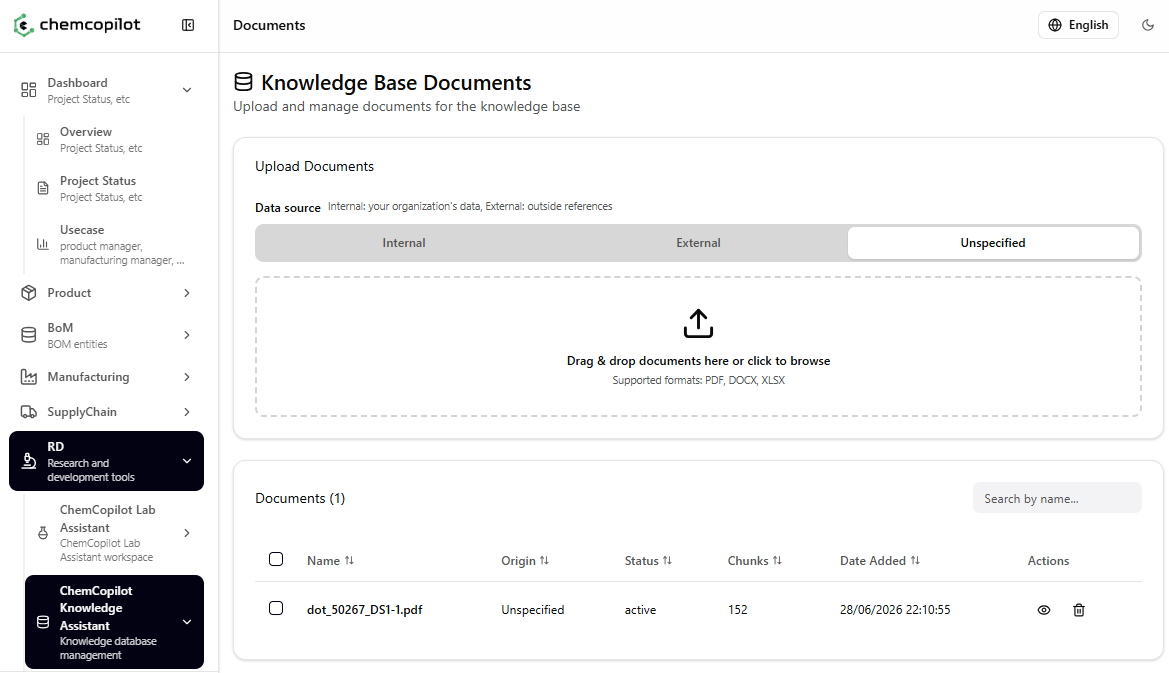
A workspace where R&D teams turn their own data, experiments, and research into a predictive AI model — then chat with it, visualize results in 3D, and use it to plan what to test next. No data science background required.
Yes — that's the most common situation. ChemCopilot ingests Excel and CSV files, PDFs (research papers, patents, internal reports), digitized lab notebooks, and live API connections from MES/ERP systems. You don't need a perfectly structured dataset to start. The more data you bring in, the better the models get.
Your past experiments, specs, and articles train the model — not random guessing. The AI then ranks which conditions are most likely to hit your target, so you run those first instead of spending weeks testing at random. A DOE that traditionally needs 48 runs is often narrowed to 5–8 high-confidence experiments. In one case, a team with 340 rows of historical batch data found their answer in 48 hours — no new experiments needed.
The platform trains multiple architectures on your data and ranks them by accuracy — you don't have to choose blindly. Available models include: CatBoost (most robust for formulations with mixed categorical/numeric data), XGBoost (best all-rounder for tabular chemistry data), Random Forest (robust to outliers, easy to interpret), MLP Neural Net (captures complex non-linear patterns), TabPFN (transformer-based, excellent on small datasets under 1,000 rows), K-Nearest Neighbors (good baseline, fast and transparent), and Extra Trees (faster than Random Forest with similar accuracy). R² and cross-validation scores tell you which one to trust for your specific dataset. Read more →
After training, the AI produces a ranked list of which input variables — temperature, reagent concentration, reaction time, etc. — are most predictive of your output. This tells your team where to focus next experiments, and equally important, where to stop running experiments that won't move the needle. Teams regularly discover that the variables they had been focusing on weren't the dominant drivers.
Yes — upload papers, patents, or internal reports and the Knowledge Assistant uses them to inform predictions and generate a Design of Experiments. You're responsible for ensuring you have the rights to any document you upload — Chem Copilot doesn't claim ownership of your content, but please respect copyright and your organization's IP policies.
Yes — to train a model, the AI Lab Agent needs your input and output variables: the conditions you tested and the results you measured. You train the model yourself, on your own data, hosted on Amazon Web Services infrastructure. Your data is never used to train models for other customers. Enterprise plans include on-premise deployment for organizations with strict IP requirements.
It's about quality, not quantity. You can start with formulation specs, measured outputs, research articles, old experiments, or historical production variables — there's no minimum row count. The more relevant and accurate your inputs, the better the model's predictions.
Chem Copilot connects to SAP, Oracle, Benchling, Dotmatics, and any ELN or ERP via REST API. It also accepts direct file imports (Excel, PDF, CSV) and processes legacy data through AI/OCR ingestion automatically. Enterprise plans include full ERP integration with read/write API access.
Most teams are running models within hours of uploading their first dataset. The free trial starts instantly — no credit card required. For Enterprise onboarding, a dedicated customer success manager supports data migration and team training from day one.
The Digital Twin is an in silico version of your process — a virtual model built from your historical batch records, BoM data, and process parameters. Once trained, you can run what-if simulations: change a condition (temperature, concentration, reaction time) and instantly see the predicted outcome, before committing a single reagent or production batch. It bridges your R&D specification and scale-up planning without requiring new physical experiments.
Yes. The free trial gives you 14 days of full access — upload your own datasets, run in silico experiments, and test the AI Lab Agent. No credit card required. Pro and Enterprise plans unlock PLM tools, digital twin, ERP integration, and team features.

Read More about Chemistry and AI

Talk with an Expert

Get hands-on access to Chemistry AI:

✓ Secure environment with your data
✓ Custom setup in days
✓ Test with your actual chemistry data
✓ Direct line to our AI research team
✓ Detailed performance analytics
✓ Cancel anytime
✓ Affordable starting plans


⚠️ Are you a professor or student?

Academic access is handled separately. Please use our dedicated academic program instead.

👉 Apply for academic access

Subscribe to our Newsletter